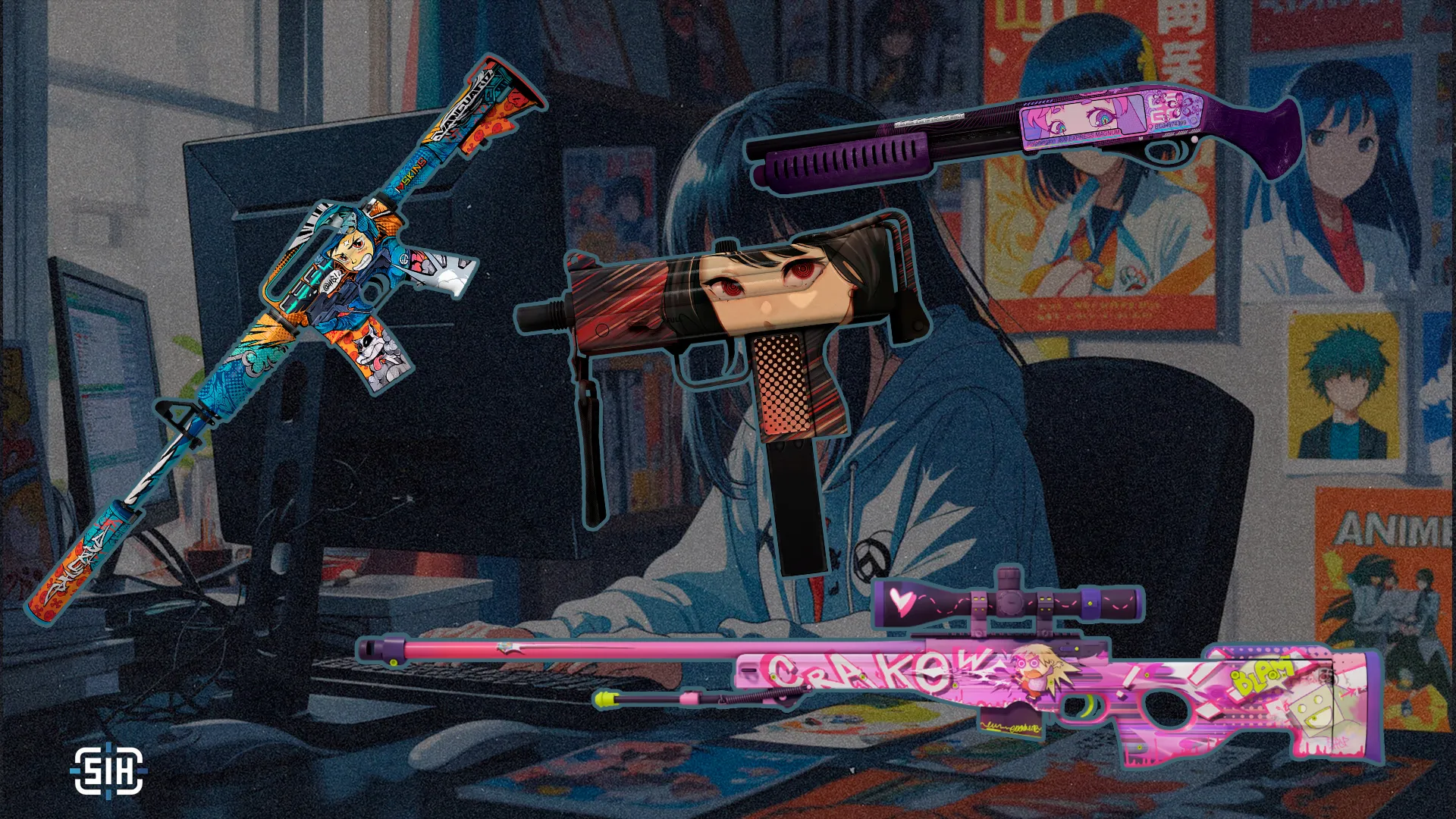
The Counter-Strike scene has always been a strange cocktail of grit, money, and subculture. Ever since skins were introduced, the game stopped being “just” about headshots. It became a marketplace, a flexing arena, a little theatre where your weapon looked as important as your K/D. Now with CS2, we’ve hit a point where anime-inspired skins are taking up real space in that theatre—and they’re louder, brighter, and far cheekier than the old guard ever expected.
Take the M4A4 Temukau for example. It’s not just one of many CSGO M4A4 skins floating through cases—it’s practically a cultural handshake. Anime on an assault rifle? That’s not just design; it’s a declaration. And the reaction it gets—whether it’s admiration or ridicule—tells us plenty about the state of CS2 player culture right now, especially in relation to the CS2 skin market and how folks approach CSGO market prices.
Contents
- 1 How We Got Here: A Short History of Skin Flexing
- 2 More Than Paint: Identity in a Tactical Shooter
- 3 Why Anime Skins Spark Debate
- 4 The Numbers Don’t Lie: CS2 Skin Market Dynamics
- 5 Generations Collide
- 6 Visibility, Streaming, and the Spotlight Effect
- 7 Global Flavor in a Western Game
- 8 What Skins Reveal About CS2 Culture
How We Got Here: A Short History of Skin Flexing
When skins first dropped in CSGO, people didn’t really think of them as identity markers. They were trophies. Pulling a rare Karambit was like winning a small lottery. Traders treated them as portable assets, while players flaunted them as proof of grinding or gambling success.
But the cultural shift happened when streamers came into the picture. Sitting in front of a camera, the difference between a flat-grey rifle and a blinding anime wrap is huge. If you want viewers to clip your ace, you may as well give them a gun that pops in a thumbnail. Anime designs, with their bold colors and over-the-top detail, slid perfectly into that need.
Fast-forward to CS2 new skins. With the upgraded lighting engine and higher-definition models, the decals look sharper than ever. Every bold pink outline or eye-catching character design is impossible to ignore. Suddenly, skins weren’t just rare—they were conversation starters.
More Than Paint: Identity in a Tactical Shooter
Let’s be blunt: plenty of people still buy CSGO skins or sell CSGO items purely as investments. They watch CS2 skin prices like traders stare at crypto charts, hoping to catch the right dip. Platforms like Market CSGO skins or Market CSGO items are busy enough to make you wonder if this is a shooter or a stock exchange.
But anime-inspired skins complicate the picture. Equipping one isn’t just about economics—it’s about saying something about yourself. Some players treat their AK with a pink-haired protagonist splashed across the side like a digital band tee. Others do it as a joke, an ironic flex, a way of telling the lobby: I’m deadly, but I’m also not taking myself too seriously.
That personal layer is what separates anime skins from the minimalist classics. The Desert Eagle Blaze? That’s just cool. The Temukau? That’s personality.
Why Anime Skins Spark Debate
Few things polarize CS2 weapon skins discussions more than anime designs. You’ll find two loud camps.
On one side, the purists. These players grew up with Counter-Strike as a gritty, tactical game. They’ll argue that anime rifles break immersion, that it’s hard to take a hostage rescue seriously when someone’s holding a weapon that looks like it came out of a late-night manga binge.
On the other side, the enthusiasts. They see anime skins as the antidote to the blandness of “realism.” For them, Counter-Strike isn’t a mil-sim—it’s a global gaming platform. Why not have fun with it?
The clash reveals something about CS2 player culture itself. It’s torn between its roots as a serious esports shooter and its new life as a social sandbox where aesthetics matter as much as aim.
The Numbers Don’t Lie: CS2 Skin Market Dynamics
Love them or hate them, anime skins don’t sit in bargain bins. A quick scan of CS2 skin prices shows they often sit above average. They’re buoyed by two reliable factors:
- Cross-fandom pull – There’s a massive overlap between anime watchers and CS2 players. That overlap guarantees demand.
- Streamer hype cycles – The second a top streamer rocks an anime rifle on stream, it circulates through TikTok edits and YouTube montages. Hype sends prices climbing.
Of course, the CSGO market prices can be unpredictable. A skin might spike after being featured in a pro tournament, only to drop when a fresh case lands. But anime pieces have shown surprising resilience. Even if the hype cools, the design still appeals to a steady subculture of fans.
So while traders jump in and out, trying to sell CSGO items for quick profit, the anime designs tend to function like cultural collectibles. They’re valuable not just because they’re rare, but because they mean something.
Generations Collide
It’s hard to ignore the generational factor here. For many older players, skins were always a sideshow. They wanted Counter-Strike to remain grounded, all steel and shadows. For Gen Z, though? Equipping an anime rifle isn’t cringe—it’s the point.
Zoomers grew up marinating in meme culture, in TikToks that remix anime clips with trap beats, in a world where irony and sincerity often blur. For them, anime skins are part flex, part inside joke, part expression of taste. When a younger squad loads into CS2 with anime gear, it’s a vibe. When veterans see it, they sometimes groan. That generational clash plays out in every lobby, and the skins themselves become symbols of who belongs to which camp.
Visibility, Streaming, and the Spotlight Effect
If anime skins had dropped in 2010, they probably wouldn’t have hit like this. The missing ingredient back then was visibility. Twitch and YouTube changed that. Now, when a streamer lands a clean 4K, the gun they’re holding is practically co-starring in the highlight.
That spotlight has ripple effects. Once fans see their favorite creator styling with a particular skin, demand explodes. Clips spread, memes spin out, and overnight the CS2 skin market reacts. Anime designs, being instantly recognizable, are especially suited for this cycle.
In that way, anime skins aren’t just items—they’re content machines. They travel across platforms, shaping perception and fueling trends outside the game itself.
Global Flavor in a Western Game
Counter-Strike began with the aesthetics of dusty maps and military realism. But the anime wave shows how globalized gaming has become. Japanese pop culture has seeped into every corner of global entertainment, and Counter-Strike isn’t immune.
What’s fascinating is how natural it feels. A pink-saturated rifle might look out of place in a grounded shooter on paper, but in practice, it feels right at home. That’s because CS2 is no longer “just” a competitive shooter—it’s a crossroads of cultures. Anime skins aren’t an intrusion; they’re proof of the game’s evolution into a global stage.
What Skins Reveal About CS2 Culture
So, what do anime skins really say? They say that CS2 isn’t a monolith. That its community is split between those clinging to tactical roots and those embracing Counter-Strike as a canvas for personal expression.
They also say that skins are no longer purely about rarity or resale value. Yes, people still buy CSGO skins for investment and watch CS2 skin prices like hawks, but anime-inspired pieces show that aesthetics and identity matter just as much.
